


300: Mortgage Brokers Are Too Stressed to Notice They're Stressed


WATCH
▶️ Watch this episode on YouTube
***
EPISODE DESCRIPTION
In this episode, I'm joined by D'Arcy Henneberry.
D'Arcy, a former mortgage broker and the current President of MortgagePal, made a major career shift in 2022 by becoming a Certified NeuroChangeSolutions (NCS) Consultant trained by famed neuroscientist Dr. Joe Dispenza. Why? The industry is facing a full-blown mental health crisis, and most people don't even realize it.
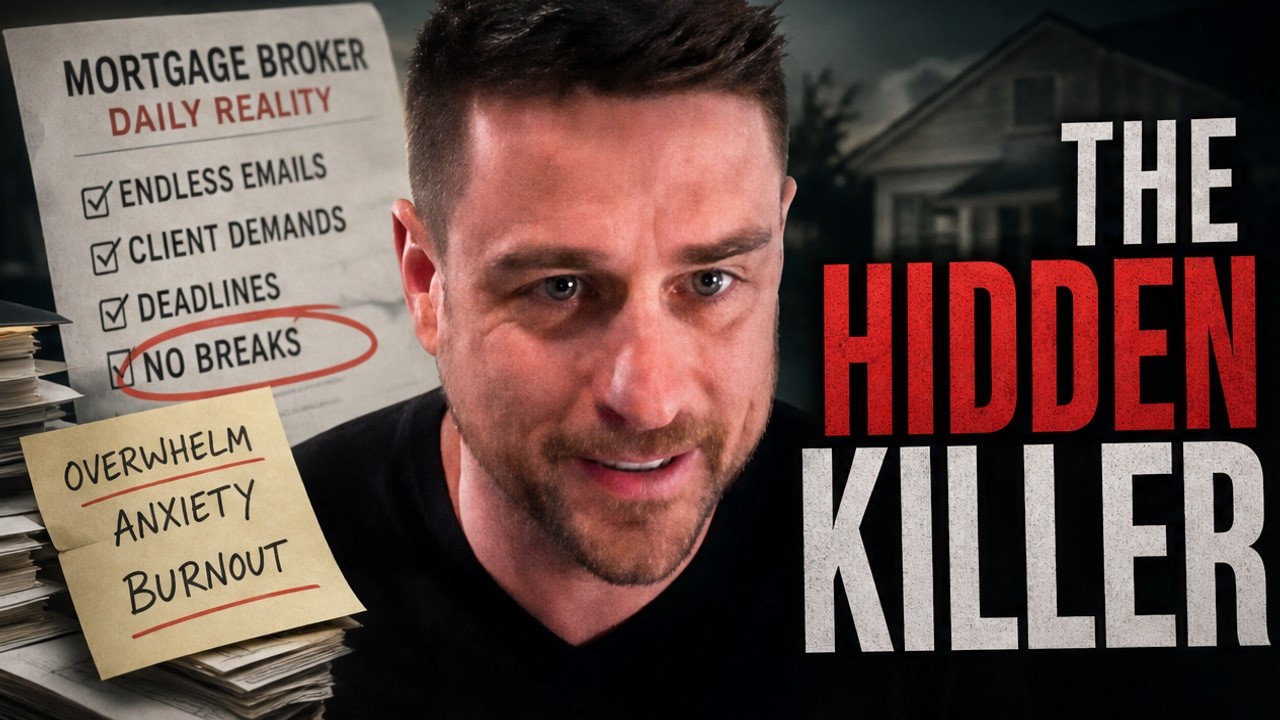
Stress has become so normalized that brokers no longer even say they're stressed. They just say they're burnt out, overwhelmed, or depressed instead. The stress is simply the baseline now, and that baseline is making people sick.
What can actually be done about it? D'Arcy introduces practical tools based on neuroscience to teach mortgage brokers to rewire their stress responses. These techniques allow brokers to better manage stress, rewire their brains, and in turn, positively change all areas of their life, including their business.
D'Arcy is here to discuss:
→ How he became fascinated by human potential and change during Covid, which led to giving up his mortgage dream, to pursue this passion and becoming an NCS Consultant learning from Dr. Joe Dispenza.
→ Calling for industry-wide change as stress has become the industry baseline, leading to brokers becoming not only overwhelmed and burnt out, but also making us physically sick, impacting every facet of our lives.
→ The science behind the stress response and how to interrupt it, what a refractory period is, and how it can last from minutes to even years.
→ The 3 steps to combat a stressful situation in 90 seconds - awareness, stop, breathe.
→ Understanding your biological state and how you think, act, and feel defines who you are.
→ The power of meditation and more practical advice that mortgage brokers can implement every day.
***
🌎 D'Arcy Henneberry's Website: www.darcyhenneberry.com
📸 D'Arcy Henneberry's Instagram: @darcy_henneberry
🔗 D'Arcy Henneberry's LinkedIn: @DarcyHenneberry
🧠 Download D'Arcy Henneberry's Meditation here.
***
Visit www.iamryanwiley.com to stay up to date on all things Mortgage Game, learn more about Team Wiley, PLUS sign up for coaching, events, our newsletter, & more!
***
CONNECT WITH ME ON SOCIAL
📸 Ryan Wiley's Instagram: @iamryanwiley
🎵 Ryan Wiley's TikTok: @iamryanwiley
🔗 Ryan Wiley's LinkedIn: @RyanWiley
👤 Ryan Wiley's Facebook: @RyanWiley
***
00:00:06 Ryan Wiley
Welcome to the mortgage game. I truly, truly believe that building a mortgage business, a successful one is like playing a game. There's winners, there's losers. There's certain things you try. Some of us are playing checkers while others are playing chess. I've had the ability to coach and mentor hundreds of mortgage brokers. I myself built a very nice business. So now I want to distill all that information, all the things I've learned from that and bring it directly to you in a simple to understand way. I hope you enjoy.
00:00:38 Ryan Wiley
Welcome to the Mortgage Game Podcast. West Coast whiteboard Wiley here. Instead of the Dodge Ram studio, we are bringing this in -house, on camera, as promised. This was always going to be the case. We were always going to get here as a matter of when. And so I'm super excited today. We're shifting gears here. This is the 300 episode of the Mortgage Game Podcast. And this was a journey I started six plus years ago. The whole point of it was to just show you, give the industry advice, insight, stuff that can just get you up to whatever volumes you want to be at, let you know that you're not alone, let you know that other people have already solved all your problems. And I had a lot of information banging around in my head, and I wanted to just get it out to you. And so now we're at episode 300. And I was originally going to talk to you about my mortgage team. And how hard it was to build and where we're at. And now I decided we wanted to tackle a bigger challenge in our industry. And so that's what we're doing today. So I want to introduce Sir Darcy Hanaberry. Hello. Hello.
00:01:39 D'Arcy Henneberry
Good to have you. Congratulations on 300 episodes over six years. That's amazing.
00:01:43 Ryan Wiley
Yeah. It's just no editing, talking into a headset in my truck, driving around at the beach. It's kind of. It is what it is. So thank you. Let's get into it. So first, let's give some background, some context to you. So you were with the Mortgage Pal, which is under Tango Financial. You were running mortgages like the rest of us. You were making bank. You were living the life. You were doing the thing, grinding away. The stress level is all time high. Thought you'd made it. All this stuff. And then what happened?
00:02:16 D'Arcy Henneberry
And not to mention a ton of career ahead of me, too. and so much more money to make.
00:02:21 Ryan Wiley
Yeah, you earned 50. Nope. So like, what happened? Because you were on this path where you were building what a lot of brokers would call the dream setup. Yeah. Why don't you explain that a bit, where the shift happened and why?
00:02:32 D'Arcy Henneberry
Yeah, well, again, thanks for having me. So take us way back. Jason and Hanneberry and I, my brother and I, we built Mortgage Pal back in 2012, 2013. And I took over as president in 2017. And it's been wonderful. Building the team and having an amazing team there has been great. And we built. Tango and Tango Financial. And it's been an amazing journey, one that I would never change. It's been a phenomenal opportunity to work with my brother and build this together. And then what happened? COVID happened. Lockdowns happened. When COVID happened, you know, we all experienced the stressors that we experienced in our industry. But at the same time, we were in lockdown. And I just happened to stumble across some really cool information about human potential and behavioral change about how powerful human beings are. I just started becoming a voracious reader. I was never a reader. I was that kid in high school that never finished one of the books that we were all assigned, you know, and I was that, you know, C average student. I might be giving my... myself a little bit of grace there. I was probably a C minus student at most parts, you know, I wasn't a big reader. But when COVID happened, I became fascinated by human potential and behavioral change. And I started studying Napoleon Hill and Thomas Troward and Genevieve Brand and many, many other thought leaders in the space. And then in the summer of 2020, after digesting all of this material, I became aware of a man named Dr. Joe Dispenza. And when I started reading his material and started watching his work, it added a scientific element that I felt was missing from all of the, let's call it spiritual realm of the information I was studying. And when that happened, it gave me an opportunity. It was like meat on the bone for me. It made sense. Everything I'd been reading about how powerful we are, about how our thoughts become a reality and feeling is the secret. These are some of the one -liners that come out of all of that material. When I started reading and listening, digesting Dr. Joe's material. It was science. It was all rooted in science. It was neuroscience and neuroendocrinology and epigenetics and psychoneuroimmunology and quantum physics. And I didn't like biology in high school. Like I wasn't a science kid back then, but this made sense to me. And as I started really learning the material, one thing really stuck out and it was the impact of stress on the brain and the body and how. We've all heard stress kills. Silent killer. It's the silent killer. Stress is the silent killer, right? And then as I reflected on this and I'm learning about how stress influences how we think and how we feel and how we think and how we feel creates our reality. And if we're constantly in a state of stress, we're creating a reality of stress and I can go down that path. I started looking at our industry. I became aware of that. Okay, if stress is the silent killer and we get stressed out because of our environment, right? Our environment made up of people and objects and things at certain times and places, right? In the mortgage world, our environment is our clients, our lenders, our underwriters, certain lenders out there in the industry that are offering much lower interest rates than we can offer with the same lender and things of that nature and clients going to those lenders. all the stuff that we deal with on a daily basis, right? I could go on and on and on about the stressors that exist in our environment, in the mortgage industry. And I thought to myself, my God, this is crazy. Like, if our environment causes us to be stressed constantly throughout the day, and stress is the silent killer,
00:06:13 Ryan Wiley
is the silent killer, stress makes us sick, then our environment,
00:06:18 Ryan Wiley
environment, our industry, by no fault of anyone specifically, is making us sick. And then I also learned that it's not just our environment that makes us sick because our body doesn't know the difference between a real -life experience that we're having in our environment and one that we're having by thought alone. To the body,
00:06:30 D'Arcy Henneberry
it's not just our environment that makes us sick because our body doesn't know the difference between a real -life experience that we're having in our environment and one that we're having by thought alone. To the body, it's the exact same thing. And so it's not just when we're sitting at our desk. And we get that phone call from our client or our underwriter and the vial blows up in our face, right? It's not just that moment that causes the stress response and we can get into the science behind the stress response. It's not just that moment. It's the moment when we go home. I was speaking with a mortgage broker one day and this really hit me hard. This is a few years ago now. She said, last night was a really hard night for me. And I said, what happened? She said, well, I was laying in bed. And I couldn't sleep because of this situation that happened earlier in the day with my client. It was literally a client was berating her, the file was falling apart, and they couldn't figure out the solution to the problem. So they're now laying in bed wide awake, and the problem is replaying in their brain over and over again. And so she said, I had to get out of bed because I didn't want to wake up my husband. And then so she was downstairs sitting on the couch, and all of a sudden she said, I don't know what happened, but all of a sudden I'm pacing up and down my living room. I'm just pacing. Have you experienced that before, Ryan? It looks like. Yeah.
00:07:53 Ryan Wiley
Yeah.
00:07:55 D'Arcy Henneberry
Right. You know what I'm talking about. Right. And so suddenly and she's like, I don't even know why I was pacing. I didn't. She didn't get up and start pacing. The body did it. Right. And so what happened there was the body was in that state of stress as if the event was actually happening. But yet she's at home sitting on a couch. It just kept going.
00:08:13 Ryan Wiley
just kept going. It's like. The definition of taking your work home and then some. Yeah, interesting.
00:08:20 D'Arcy Henneberry
So that really hit me because to land the plane on this thought, it's not just our environment in the moment that's making us sick, that's causing the stress response that's making us sick. If our body doesn't know the difference between a real life experience that's creating an emotion or a physiological response. If our thoughts can do that as well and our thoughts can activate the stress response, then our thoughts can make us sick. And what I've discovered through this work, through studying Dr. Joe's work, is that if our thoughts can make us sick,
00:08:52 Ryan Wiley
that if our thoughts can make us sick,
00:08:54 D'Arcy Henneberry
then is it possible then that our thoughts can make us well? And through the scientific research that he's doing with the University of California, San Diego, there is... Hundreds and hundreds, if not by now, thousands of people, of testimonials, of experiences where people have had significant chronic disease that have actually been able to use this work to make them well.
00:09:19 Ryan Wiley
By rewiring your brain. By rewiring the brain and reprogramming their subconscious mind. By rewiring the brain and reconditioning the body to a new mind and to a new emotion.
00:09:21 D'Arcy Henneberry
rewiring the brain and reprogramming their subconscious mind. By rewiring the brain and reconditioning the body to a new mind and to a new emotion. That's where this really can go. Wow.
00:09:31 Ryan Wiley
Okay. So that's a lot. I want to just go back a little bit here and help people connect the dots because you're running a mortgage business. COVID comes, you stumble onto this. It's intriguing. You go down the rabbit hole and you're like, oh my God, you bring that back. At what point do you go, do you try to help yourself in your own mortgage business? Do you try to help your team in your own mortgage business? And then at some point, are you like, oh my God, the whole industry needs this? And then when did the mission change? Yeah, for you.
00:09:58 D'Arcy Henneberry
Great. So the mission really has been evolving throughout these years. And very recently, I would say, has really fired me up to the point where I recognize that this is a critical moment. I started teaching Earl Nightingale and other concepts to my mortgage team from a business perspective, from teaching them, like, change your mind, change your results, that kind of work. And it was received very well. One person came to me and they said, you know, I really like what you're talking about. But to me, it's woo woo. And they use the words woo woo. And that was the first time I'd heard of the words woo woo. I was like, oh, OK, tell me more. And I thought, my God, like this material works. I had already had my own personal experiences where I had created an intention and experienced that, you know, amazing results that I had experienced, which. are irrelevant, but like prove to me that the work really works from creating your own results perspective. But this work goes way beyond that. And when he said woo woo, I thought, OK, I know the work works. So it's not the works that's the problem. It's the language that I'm using that needs to change. And I went with that to my very first Dr. Joe Dispenza retreat in September of 2022. And when I was there, I was. blown away by the content and also by his ability to speak. Like I've never seen anyone speak like he can. It's incredible. And while I was there, I was like, man, this this is the language I want to teach. This is it. The language of science. Science demystifies the mysticism and it pulls together an audience. It really helps us deliver a message and make it land for an audience because you can sink your teeth into science. It's evidence based. Right. Anyway, while I was there, long story short, while I was there, I discovered that I could teach his work and I became a neuro change solutions consultant trained by Dr. Joe Dispenza to teach his work. And that is the change your mind, create new results class that I teach. To go forward in the mission, though, as I was teaching this work to various people in the mortgage industry, business development managers and mortgage brokers, some of the feedback I was receiving was not only did their performance increase at work, which is great. That's awesome. We want our performance to increase at work. But the stuff that really landed for me is when they told me that the relationship with their spouse, the relationship with their children has improved. That is, that's everything. Because why are we doing this in the first place? Why are we working our butts off in the mortgage industry? Sure, we're doing it for the Canadian public. We're helping them get into the Canadian dream, right? Homeownership and everything. We're supporting them financially. That's awesome. We're also making a phenomenal income. in this industry, right? It's great. We're doing that for ourselves, for our family.
00:12:42 Ryan Wiley
But if we're making ourselves sick in the process, and that's really what landed for me is there are people in our industry that are getting sick.
00:12:47 D'Arcy Henneberry
what landed for me is there are people in our industry that are getting sick. You know what? I'm just going to say it straight. We have a serious problem in this industry. We have a serious problem. When I was at CMBA BC last year, the conversation I kept hearing was stress. A lot of stress. People are stressed. This year, I didn't hear the word stress once. That was striking to me. It's normalized. It's normalized. You know what the word I was hearing? What were you hearing at the event?
00:13:15 Ryan Wiley
I heard people fatigued, just kind of like so depressed, down, like just like the mojo was definitely missing. A lot of I'm exhausted, fatigue. Exhausted, fatigue, mentally, physically.
00:13:27 D'Arcy Henneberry
Overwhelmed. Wow. I bet you every single person that's watching this has said the word overwhelmed recently. One striking moment for me was when I spoke with three different women mortgage brokers over the course of about 17 hours, over two different days, but it was about 17 hours. Each one of them on their own, completely independent of each other, said they were overwhelmed. I'm thinking that's that's striking. But at the conference, the word overwhelm, I'm exhausted, I'm burning out and I'm burnt out. Those were the words. And there was people on stage that were talking about that, that the conversation is moved from I'm stressed to I'm burning out or I'm burnt out. That means then that stress is our new baseline state in this industry. And the World Health Organization is talking about the fact that stress is the epidemic of the 21st century globally. Right? In our industry, we're seeing that everywhere. And if stress is the new baseline state, then we're all on a path toward dis -ease. And we can get into all of the science stuff, but we don't have enough time for that. So if anybody's interested in nerding out on this stuff, we can definitely do. But like, it doesn't have to be this way. That's my point here.
00:14:42 Ryan Wiley
point here. That's where I'm going with this. I'm like, so. You've recognized that you and just for reference for people, you have this very nice business and you still do to some degree, but you you took a big haircut.
00:14:56 Ryan Wiley
Yeah.
00:14:56 Ryan Wiley
Like I'm talking like this is how passionate you are about this is you walked away from a bunch of money to go try and help the mortgage industry tackle this, you know, pandemic. Yeah. That we're now approaching. But I just want you to confirm that like you were humming along like a lot of people watching this. Or listen, you were just humming along with the mortgage dream, right? Not only that,
00:15:19 D'Arcy Henneberry
only that, dude, but I want to say I had it pretty easy. I don't have kids. I didn't have a spouse at the time. I was able to work my hours and enjoy my life. I was making really good money. I personally didn't have a lot of stress. I'm not one of those people out there that were like, yeah, I changed my life because I got really stressed out and I had to make a difference. I didn't have to do that. I personally wasn't. I just saw. that our industry has a serious problem. And this was back in, you know, years ago now, and it's only compounded since.
00:15:46 Ryan Wiley
So why do we think that is? Why do we think it went from stress to fatigued? Is it because of what's going on, your opinion, with they're getting hit from so many spots with the price of things going up, income not raising accordingly, 100 % commission based, what's going on in the world, the world feeling like it's tearing us apart, the pressures of the household and providing for the household with also The pressures of maybe supporting a team and then keeping up with your clients and feeling like you always care more than everyone else. is there something you can put your finger on or is it a combination of all that and more all of that and more it's the compound effect of stress let's talk about what a baseline is just to give some context to what i mean by baseline when you set a temperature in in your house to a particular setting the machine that is your house the air conditioning the hvac is always going to set to maintain that temperature right you can have people in the room that
00:16:20 D'Arcy Henneberry
of that and more it's the compound effect of stress let's talk about what a baseline is just to give some context to what i mean by baseline when you set a temperature in in your house to a particular setting the machine that is your house the air conditioning the hvac is always going to set to maintain that temperature right you can have people in the room that That temperature is a suboptimal temperature for them. Even though it's a suboptimal temperature for them, the machine has been set and it's going to always maintain that temperature, right? Stress has become the baseline state in our industry. And it's individualized and it's systemic in the industry. It's sad. And it's sad. And so I had a mortgage broker that reached out to me recently based on one of my social posts and was like, hey, I got a problem. I said, what's your problem? She said, my business. is in good standing. My relationship with my husband is good. My children are healthy and my relationship with them are good. Everything's good. I have no reason to be stressed. What's your problem? I wake up every morning stressed out. I wake up every morning in a state of anxiety. That's because her baseline state is anxiety. Because we create a baseline through habit. through habitually operating the same way over and over again. And so that creates a compound effect over time. And so now our industry has been operating in this state for so many years that it has been normalized, as you said, and biologically baseline state. And you can't change a baseline by thought alone. You have to get into the operating system of the machine that is our body. And the work that Dr. Joe teaches that I've learned to teach. gives you the manual to the machine that is your body.
00:18:09 Ryan Wiley
Wow. So this has all been happening all around us live time. And some of us recognize it. Other people just accept it as another day at the office. It's because interest rates went up. It's because lenders are not getting back to us in time. It's because the banks are killing us in rate wars. It's because like, but you're saying, no, no, no, no, no. It's not that at all. It's because we've just accepted this new baseline. And that's where our body's dealing with and our mind's dealing with. So we need to rewire that. We need to change our baseline because all the other stuff can always be happening all the time anyways.
00:18:44 D'Arcy Henneberry
Totally right. So yes, it is all of that stuff. I'm not saying it isn't. It 100 % is. That's the environment. And we have become conditioned to operate a certain way in that environment. The work here isn't to change the environment. We're not going to go out there and change the way that the system is operating. But we can change the way that we operate within the system. And we react to it? 100%. And change reaction to response. Reaction is an automatic, unconscious way of reacting. And it's generally done in an emotional state. a suboptimal emotional state. Fear, anger, worry, doubt, anxiety, jealousy, control. These are emotions of stress. When you learn this material and you learn these tools, you can actually become aware that you're in that state of stress and shift into a different state. I remember Tony Robbins used to,
00:19:35 Ryan Wiley
remember Tony Robbins used to, I went to a couple of things way back when, the walking on coal stuff. And it was like, he always talked about state. And he always talked about, you had to have the tools with you in the moment. Like you're armed, you need to be able to recognize when you're in that state. And when you are, you recognize it, you pull out the tool, bam, and you're like, change. Is that what we're talking about is learning to recognize and then we need to get the tools from the journey you're on? Is that where we're going with this? 100%. Give me some specifics. Give me a couple things that the average mortgage broker, they're in their day -to -day, either in the office or at home. A couple of live world examples you can recognize. And then let's talk about a tool. that you could use something where they don't have to go off and learn right and i know it goes a lot deeper than this but i want to give some people to something to chew on enough so that maybe they want to go do the research themselves and go down the path you went to some degree.
00:20:28 D'Arcy Henneberry
What's a situation that one of your brokers came to you recently with where they were really feeling the state of stress?
00:20:33 Ryan Wiley
You had a file that clients you've worked with in the past and everything was all great. You worked with them. Then all of a sudden, two weeks before close, and you spent six months working with them, showing different scenarios. Two weeks before close, they come to you and they go, hey, RBCs hit us with 369. I have a 404. oh my God, I did all this work, blah, blah, blah. I'm so stressed. And now we're in the right game. Buy down doesn't even work. And you're just sitting there going, how am I going to feed my family? And you start losing your confidence. And you're like, is this the new industry? Is this, how do I overcome that moving forward? How do I learn from it? But that's the most common one I see right now is getting crushed by the bank at the last second from clients you thought you were going to be working.
00:21:10 D'Arcy Henneberry
I've had many brokers come up to me with that same scenario. In fact, just on Thursday. I had a broker come up to me and call me and be like, everything's falling apart. My whole day is falling apart. Yeah. What time was it? It was like one o 'clock in the afternoon.
00:21:25 Ryan Wiley
The wheels fall off after that. It's like you can't do your social. You can't do all the productive things you do in your business because you're just like, oh, man.
00:21:32 D'Arcy Henneberry
Yeah.
00:21:32 Ryan Wiley
Like, why even bother?
00:21:33 D'Arcy Henneberry
This is serious stuff. Like, we don't need to get into the actual examples, but like. When she was telling me, I was like, oh my God, you got some serious issues here. You know, she's been taking my coaching and she knows the tools, she knows the work. And so I gave her the material. She went and she did the work and then called her later that day. And I said, so how did the rest of the day go? And she said, you won't believe this. I did everything you told me to do. And within an hour, it was all solved. It's very simple. But just because it's simple doesn't mean it's easy. But it is simple. Tool number one, awareness. In science, it's called metacognition, the act of observing self. Let's go with awareness.
00:22:10 Ryan Wiley
Awareness. Number two, stop.
00:22:17 Ryan Wiley
You got to stop the process of stress. When you're in a state of stress,
00:22:21 D'Arcy Henneberry
stress, you're in a state of survival. Survival is what the body innately does when it perceives a danger in your external world. Okay. And when that happens, the sympathetic nervous system kicks off. That's our fight or fight nervous system. And you're in a state of fight or flight. Right. And the whole system dysregulates in order to protect the body. Your salivary juices shut down, your heart rate increases, your respiratory rate increases. All the blood is shut down to your internal organs and shunted out to the extremities to prepare to run, fight or hide. It's not a time to digest food. This is why people get digestive problems when they're constantly in a chronic state of stress, because your organs are literally. out of blood and shut down so that you can run fight or hide. Not a time to digest food, not a time to think creatively about the problem that you just described that we have every day in our industry. It's not a time to do anything but to run fight or hide to survive.
00:23:12 D'Arcy Henneberry
So when that happens, there is a whole process, a neurological and a biological process that happens. In short, a chemical messenger is sent from your brain to your body, down your spinal cord. to extreme adrenaline into the body, cortisol into the body. And that's in order to generate that amount of the energy that you need to run fight or hide. Problem is you're not out, you know, fighting a lion or anything like that. You're literally sitting on your couch or whatever. And so once it extremes that adrenaline in the body, the brain is checking with the body and goes, you're really angry. Let me create more thoughts. on how you're feeling and you end up into this thinking feeling loop, that spiral or cycle of survival, I like to call it. And now you're just kicked off and you can't think creatively. You know where I'm at, right? Yeah,
00:23:58 Ryan Wiley
yeah. So then that chemical of adrenaline only lasts in the body for roughly around 90 to 120 seconds.
00:23:58 D'Arcy Henneberry
So then that chemical of adrenaline only lasts in the body for roughly around 90 to 120 seconds. So if we can just stop, so we can become aware that we're in that state of stress, we're in survival mode and we can just stop. The thoughts from activating the chemical messenger to excrete more adrenaline, which then influences more of the same thinking and we're in that cycle of survival. If we can just stop the cycle of survival for a minute and a half to two minutes long enough that that chemical messenger no longer excretes more adrenaline,
00:24:32 Ryan Wiley
excretes more adrenaline, then we can go on to the next phase, step number three, which is breathe. Okay? And so while we're stopping, we want to breathe.
00:24:46 D'Arcy Henneberry
And it's a really simple breath tool we can give to the group before we're done or call. And we're going to breathe. And that breath takes generally around 90 seconds, coincidentally. And the whole system slows down. Your brainwaves slowed down. Your heart rate slows down. Blood goes back into your internal organs. And the whole body moves from a state of dysregulation or incoherence to regulation, to balance, to harmonization, to coherence. And when we're in a state of coherence, you can now think creatively. And that's where solutions can start to come.
00:25:24 Ryan Wiley
Most people never stop. That's right. They come in and they just keep going, which then the 90 to 120 seconds just keeps cycling through and just more adrenaline, more adrenaline and more. And you're sitting there and you're just staying in that state. Whereas if you would have just stopped, go in a corner, maybe we give some best practices around that, but you just, and then you start breathing like you said. So you're saying that quickly you can recenter yourself? 100%. That's crazy. That's crazy.
00:25:51 D'Arcy Henneberry
That's why I guess we're fired up about this work because... We don't have to be doing the same old stuff. We don't have to be in this state of survival in this industry. It does not have to be this way. Learn a few bits of how your brain and your body work that gives you the knowledge that you need in order to actually become aware you're in the state to be able to stop, breathe, and change. Change is the reframe. Change is shifting from that state of survival to a state of creation, right? To being in the zone when you're in flow, if you will. And how many people... Because I coach on a lot of,
00:26:22 Ryan Wiley
how many people... Because I coach on a lot of, you know, sales, marketing, a lot of stuff where you need to tap into the creative part of your brain with social media, scripting, all that stuff. Yeah. A lot of people, the brokers, they have all these great intentions and it goes in the calendar and they're feeling it and blah, blah, blah. But then the shit storm of a day happens in our industry. It is every day. You drink it from a firehouse and it comes in, but they don't have the tools like that. So the adrenaline's pumping and they stay in that state. And then they look at their calendar and they're like, oh, now I got to create content. And they just. The brain can't even get there. And then all of a sudden, they just go, I'll do it tomorrow. And they shut down. And then tomorrow shows and they don't do it. And then you check in two weeks later, and they've done two pieces of content, even though they know they should build a brand on social media. But when you reverse engineer it all back, it was they set themselves up to fail because they didn't have the tools, A, to recognize the awareness, and then the tools to change the state. That's right. I'm starting to see it now. I never understood the disconnect on some brokers. on how they can't perform prospecting, creativity stuff, social media. I've never got that because I'm just like, I think I naturally do what you say so I can always get back to my regular state. The average person I'm dealing with can't. They're not equipped. They haven't heard this. And so they're never going to go down that path and then their business suffers, which then just stockpiles back on to the stress. And then you have this whole loop that just keeps going. Interesting. And so we call that a refractory period.
00:27:49 Ryan Wiley
so we call that a refractory
00:27:50 D'Arcy Henneberry
period. A refractory period is the amount of time between when you have an emotional response to when it's over. Can we name it something else? Refractory period?
00:28:01 Ryan Wiley
Can we name it something cooler? Sure. What do you want to call it? I don't know. The Wiley period. Get all Wiley. Okay, we'll do refractory.
00:28:15 Ryan Wiley
But you're saying that's what it's called from. awareness to back to regular state.
00:28:21 D'Arcy Henneberry
So when it's over. So the refractory period, depending on the individual, can last for hours, days, weeks, months, years. And so when it's days or weeks, we call that a mood. Somebody's like, oh, I'm in a mood. Just give me a moment. Right. If that refractory period lasts for weeks or months. It's called a temperament.
00:28:39 Ryan Wiley
I got you. If untreated, you're telling this it is if it's treated, then that refractory period is much smaller.
00:28:46 D'Arcy Henneberry
If it's treated, we can shorten our factory period. Otherwise, that person is going to be in that state for months or years. And you'll be like, why are you this way? I'm this way because of that thing that happened to me four years ago. And I haven't been able to change back since. That's where this industry is. We are in a long standing refractory period where stress has become the norm. And now the industry is burning out. as a whole. I'm going to throw another curveball at you.
00:29:09 Ryan Wiley
going to throw another curveball at you. Like, this is all hitting me pretty fast. And I'm like, I'm starting to see things pretty clear. We don't even have to go down this path a lot, but you have that. Now, imagine you're a female. You're a female and you've got that in this industry. And then you've got the whole perimenopause and you like start layering that on. So that's a whole nother, I don't know if you've talked about that or not, but there's so much more awareness around that. It's been around us for so many years. It just wasn't called that. It was just called like, she's a bitch or she's short -tempered or she's just being a chick or it's hormones. But it's like, that's a whole thing. Just stockpile on top of this. I don't know if it bleeds into each other there.
00:29:48 D'Arcy Henneberry
It 100 % does. And I was just at an event in Vancouver where Gabor Mate was the lead speaker. It was a really cool event because there was a number of physicians and doctors and governor on stage. And then there was holistic practitioners on the exact same stage. Most of the speakers were women. In fact, most of the audience was women as well. And they were talking about perimenopause and menopause and the effect of stress in conjunction with all of that. And I've got a lot of studying and a lot of learning to do around the impact of all of that. So I'm not prepared to really speak to how it integrates other than it certainly does. The conversation is out there and I have a lot to learn about it. But what I really picked up from that event, one thing was that the medical industry is ready for an understanding that to heal an individual, it goes beyond medicine. It goes beyond pharmaceuticals. It's really the mind -body connection. These are doctors, these are family doctors that were saying this on stage. So it's amazing. They literally were saying there's a shift. They also said that we don't have a healthcare system. in Canada. We don't have a health care system in Canada. We have an illness care system in Canada. And in order for it to become a health care system, we've got to get to the root of illness, which is emotion. And what they're talking about is the same thing I'm talking about, is that it is those emotions of stress that is really dysregulating our body. And if we constantly are in that state of stress, we're constantly moving into a state of survival, whether you're a man, whether you're a woman, whether you have perimenopause or not. We need to learn how to shift from that state. So let's have another call in a little while about perimenopause and stress because I'll give myself a bit more. We will speak to it more. It's a real thing.
00:31:35 Ryan Wiley
thing. And if you think about the cocktail that's brewing of emotions inside men as well, but women, you throw that in the mix and you're just like, oh my God, you're like, I get it. I totally get it. You never know until you walk a mile in someone else's shoes what they're going through. And we'll bring this full circle here because I want to have you back. and talk about this in more layers. This was like step one of just you and I talking about bringing awareness. I learned some things here. I learned become aware, get through the 90 to 120 seconds of peacefulness. Is the breathing included in that? Or do I, yeah, okay. So I, cause I have to breathe. So I'm going through my breathing. And then after that, is there something like the science backs that? I should be good from there on, or is there another thing to keep you in that state, something you recommend? Yeah,
00:32:26 D'Arcy Henneberry
good question. So to answer that, let me back up a little bit. We've talked a lot about state, but we haven't defined what state is. I think that would be powerful for us to do. Sure. It's your biological state, and it's created by how you think, how you act, and how you feel. So my version of Ryan Wiley,
00:32:41 Ryan Wiley
my version of Ryan Wiley, that's my state, like me in my purest form. Your identity,
00:32:46 D'Arcy Henneberry
identity, how you think, how you act, and how you feel. OK, your identity is how you see yourself and stuff. It goes beyond that. But it's how you think, how you act and how you feel. Call that your personality. Call that your your state. OK, and it's how you think, act and feel is what actually creates our perception of reality. So it creates our reality. You're having your perception of this interview. I'm having mine. The next person that's watching is having theirs. We're interacting together. You have 100 people in a room. You have 100 different realities in the room because you have 100 different personalities room. You with me? OK, so then we've got this personality. That we're habituated in being. We are in the habit of being ourselves. Yeah. Okay. And a habit. Good or bad. Good or bad. It's just our baseline. It's who we are. We've practiced it so many times. It's become innate in us. Right. And by the time we're in our mid -30s, 95 % of who we are are subconscious programs. They're habits. Okay. And a habit is when the body knows how to do something better than the conscious mind. Okay. So then as we go through our day, we're going throughout our day. as being in the habit of ourselves, we then become aware we're in a stress response. We become aware we're in a moment that is a very powerful moment. That awareness moment is everything because now you can do something about it. Once you're aware of a subconscious program, it's no longer a program. Now it is a choice. And the hardest part about change is not making the same choice as you did the day before. And so when you become aware that you are in that. emotional state, that state of survival, now you have a choice. You either continue to go down that path, take a left turn of the same old self, or you take a right turn and you move into a new version of you, a new personality. You're going to think differently. You're going to act differently. You're going to feel differently with intention. That's going to produce a reality you desire. And so it's best to do this ahead of the experience, to become aware of the reality that you're living in right now. pieces of it that you don't like, right? Part of your reality that you don't like, that you'd like to change. And then think, okay, how am I thinking and feeling that's creating that reality? Step one. Step two, what's the reality I do want to live in? What's the experience I want to have in my life around my business, with my spouse, with my family, with my kids? How do I want to interact with them? Is that like a vision board?
00:35:08 Ryan Wiley
that like a vision board? Is that like, are you talking like you get that out or you're just saying, I'm just talking, write it on a piece of paper.
00:35:14 D'Arcy Henneberry
Yeah, yeah. Sure, vision boards are great too. Just sit it down on a piece of paper. If I was living the life I want to live, what life would I be living? You hear that all the time. I always thought it was foo -foo. Exactly. Foo -foo, woo -woo, right? But it's just real shit. And so, and then it's like, okay, if I was living that life, how would I think? How would I be thinking? How would I be acting and how would I be feeling? What's that version of me that's living that life? Think about that ahead of time so that you can start to build that neurological network in your brain. Sorry, I want a little science there. But you got the wiring in the head, okay? Now you've got a little bit of an understanding. So then when you're in the moment, you become aware you're in stress. You know, okay, I'm in stress. I'm just going to pause. I'm just going to pause and I'm going to... Farsi said, pause. Okay. I'm just not going to think about the situation. It can wait for a couple of minutes. I'm going to breathe. I'm going to take a nice, slow, deep breath in for five seconds. I'm going to hold it for five seconds. I'm going to exhale slowly for five seconds. I'm going to hold it for five seconds. I'm going to do that five times. Okay. That's what I call the resilient reset. simple box breath tool. And it'll reset the system, slows down the brainwaves, brings the body back into harmonization and balance. And through that process, you're no longer extending adrenaline and you're bringing the body back into balance, moving it from stress into that zone of creativity. And then now that you're in that state, before you open your eyes and you're done, you're breathing and you can feel the whole system is settled. All I want you to do now is just think about who you do want to be. Who do you want to be in that moment? What is the version of you that's living in the reality where that problem no longer exists? That problem is solved. How does that version of you think? How does that version of you act? How does that version of you feel? Now, solve the problem from that state.
00:37:05 Ryan Wiley
You know what I noticed you didn't say? You didn't say, go tell people about the problem. And it perpetuates. And it just starts. And now you're just... And like, you're not, you're no longer addressing it. You're actually going far on that left turn. That's right. Which is what a lot of people do. Right. And there's, there's a moment for that,
00:37:22 Ryan Wiley
that, but. Interesting. Man.
00:37:25 Ryan Wiley
Oh man. I can, I can just feel the passion through the, the screen here. This is just the tip of the iceberg. Like I could tell, like you could just, we could go, this is like a four day retreat thing.
00:37:35 D'Arcy Henneberry
I'm holding myself back. I know.
00:37:38 Ryan Wiley
I know. And I appreciate that. We will be able to bring that out though more. I think there's a way to take what you're talking about and build useful tools and bring that into specific situations in our industry, which is what you're already planning on doing. And that's the path you're on now. And you're getting on stages and you're getting on podcasts. Are you brokering at all anymore?
00:37:58 D'Arcy Henneberry
No, I stopped brokering so that I could focus on this completely.
00:38:02 Ryan Wiley
Interesting. So, yeah. And I know you told me that. I just want everyone else to know.
00:38:06 D'Arcy Henneberry
Yeah. I still oversee Mortgage Palette. I'm part of Tango and I'm broker pulse manager in Tango supporting our agents there. This is my passion. This is really where I want to make a massive difference. Do you feel,
00:38:14 Ryan Wiley
you feel, because I feel this when I coach, do you feel frustrated that other people can't see what you see? and that they're so close to fixing something that's such a big problem or that they won't even stop to realize how big of a problem it is. Like, has that crept in at all for you yet or you're still too new to the journey or you have tools to combat that?
00:38:35 D'Arcy Henneberry
All three are real at the same time. I'm still new in the journey. Yes, I get frustrated. I got frustrated today. You know, I sent out what I thought was a great email. I've got a class coming up. It will be done before this airs. We'll have more classes. At the conference, so many people came up to me telling me how stressed out they are, how much they want. They see my information. They want to do the work. And then I invite them and they're not signing up for the class. And I'm like, yeah, I got frustrated. But then, yes, third one, I do the work. I let that go because frustration is an emotion of stress. And so if I stay in that, I'm dysregulating my body. I'm creating a reality that I don't want to experience. No, I don't sit in that. I do the work and I shift and I trust whoever's meant to be in the class now will be in the class now. Every single one of us is on our own journey and it's totally cool. And it's my job. It's my duty. It's my responsibility to continue to show up and to express myself. And there is already a sea change. I can feel it. There is already a compound effect of my effort and it's my job to continue to show up. And I trust that over time, this industry will experience a change. That's my passion. And that's what I want to do for the industry.
00:39:43 Ryan Wiley
Well, it's only going to get there with people like you leading the way because like you're the only one I've heard talk about it this way. I heard people give the easy solution. Everyone's stressed, but there's no solution based stuff. There's no like, so now what? Now that we've identified this and we get it, what do we throw another party with free drinks? Or do we actually like do this? Like that's like to me, I'm like. Okay. I felt worse. It's a pandemic. Like it is, it is. And it's happening right in front of me now that I have my own team and I'm connected daily in the trenches with them.
00:40:10 Ryan Wiley
is, it
00:40:17 Ryan Wiley
Oh yeah. Like I see, I feel it and I take it on. So I'm going to use some of what you said as well, but okay. For those who are listening, if you want to get in contact with Darcy, we are going to put URLs and links to everything. If this is on YouTube, they'll all be in the description. So please check that out. Let's also put a link into a meditation I created.
00:40:32 D'Arcy Henneberry
put a link into a meditation I created. So we haven't talked about meditation. Just briefly, if you can't meditate, if you don't know how to meditate, if you got that idea, it's totally cool. Think of it as mental rehearsal, just like an athlete, you know, visualizes and mentally rehearses their shot or their game or whatever. That's what meditation is. It's about. becoming familiar with. That's the definition of meditation is. I put this out there because it's a nine minute meditation on coherence and we're not going to get into it, but I've got an intro to the meditation that'll be there to educate you so that you can actually do the meditation. Do yourself a favor, give yourself nine minutes, listen to the short intro, do the short meditation, follow along, and you will experience the shift from whatever state you're in to a state of coherence and coherence is everything. And we can do a whole podcast on coherence. But as you get your heart and your brain into a state of coherence, you can get into a really powerful state of creativity. And I guarantee you, you will shift your experience in your reality. So give it a try.
00:41:33 Ryan Wiley
Question for you. Is there like a weekly meditation you could have scheduled or you come in and you lead it and we bring the people and I'm talking about my team, my team joins up. And we sign up and we figure out what that looks like behind the scenes. And it's like a weekly, like, is there value in that? Or is this something that's a daily thing? Or is that a start? Is it better than nothing? It's virtual, so it's not in person. Like, is there any value in that from your opinion? Let's do it 100 % as extreme value.
00:41:59 D'Arcy Henneberry
as extreme value. Extreme value. When I was doing my talks last year, I spoke at a number of different events in the mortgage space, including MPC. I led, I don't know, 150 odd people through a meditation after giving them a 90 minute talk. it was incredible the number of people that came up to me afterward we did a seven minute meditation and i asked them how long do you think that meditation was and they said i don't know three four five minutes and i was like it was seven and a half minutes and you could hear this gasp in the room because a lot of them hadn't meditated before or believed they couldn't meditate which is fine but that's because we got this preconceived notion of what meditation is and the way we teach meditation with dr joe and like the basic stuff is not what you think it is. It's not at all. And so we can get into that. I think a weekly one would be great. But a lot of people came up to me being like, I couldn't meditate before. I've never meditated in my life. And that was incredible. And their eyes were red from the experience that they had. And so I think a weekly opportunity to get people. Oh,
00:42:54 Ryan Wiley
we're doing it. We're doing it. Let's do it.
00:42:55 D'Arcy Henneberry
do it.
00:42:56 Ryan Wiley
Okay. That's awesome. Darcy, man, much love, brother. I love just, you know, and how you're tackling that for the industry for us. You're doing things no one else is doing. for us. And you're impacting lives without even realizing it. And there's a ripple effect to this. And so I'm so curious 12 months or 24 months from now, like where you're going to be with this stuff. We're going to stay along the journey with you. So I appreciate your time, man. Thank you. Thank you for having me. And thank you for spreading the word. Appreciate it. Okay. Peace out, everyone. Thanks for listening.
00:43:36 Ryan Wiley
I'm happy.